Technology Takes A Look At A Pliosaur Skull
 |
| Source: Flickr |
The article “Colossal pliosaur fossil secrets revealed by CT scanner,” caught my attention because it describes an interesting new use for existing technology. Researchers took the skull of a pliosaur, a creature that lived in the oceans during the Jurassic period, and scanned it to learn more about the fossil remains – which may belong to the largest pliosaur yet to be discovered.
The creature is estimated between 10-16m, based on the skull which is 2.4m long. By comparison, a killer whale is 5-8m and a human is only 1.5m. Needless to say, these things were big. According to the BBC article, a pliosaur would have had the jaw strength to bite a car in half.
The CT scanner used for the research belongs to the University of Southampton in the UK. The machine is one of the largest of its kind, which was necessary to beam through the dense fossil to form a 3D image of what the inside of it looks like. The findings may be able to help researchers establish if their fossil is a different species, or just an abnormally big example of a pliosaur.
Elephant Species
 |
| Source: Wikimedia Commons. Photographer: Johnny Liunggren. |
Researchers have put an end to debate about whether the African Elephant is one species, or two. New findings published in the journal Public Library of Science Biology show that the African Elephants that dwell in the savannah are a distinct species from those that dwell in the forests.
Loxodonta africana, the savannah dwellers, are much larger and in some cases twice as heavy as Loxodonta cyclotis, the forest dwellers. The debate about whether the elephants were separate species has been going on for at least a decade. The research shows that the two species diverged from their common ancestor around the same time that humans and chimpanzees evolved. How long ago the species split was a surprise for the researchers.
What Happened to Amelia Earhart?
 |
| Source: Wikimedia Commons. |
Bones found on an island in the South Pacific are being tested against surviving members of Amelia Earhart’s family to see if the remains could belong to the famous aviator. Earhart disappeared in 1937 during an attempt to become the first woman to fly around the world. Her mysterious disappearance has been the topic of books, movies, and enough speculation to make her a household name – even today.
Along with other artifacts found on the island including makeup and glass bottles, a DNA confirmation that the bones belong to Earhart would finally put to rest the mystery of what happened to her. If the bones are Earhart it would be valid to conclude that her plane crashed, and that she survived as a castaway for some time before dying on the island.
If DNA can give an ending to the story of Amelia Earhart, it will definitely be a win for genetics, and scientific research in general. The question that would be left (at least for me) is what happened to her plane (or her navigator for that matter)?
Woodpeckers From Space
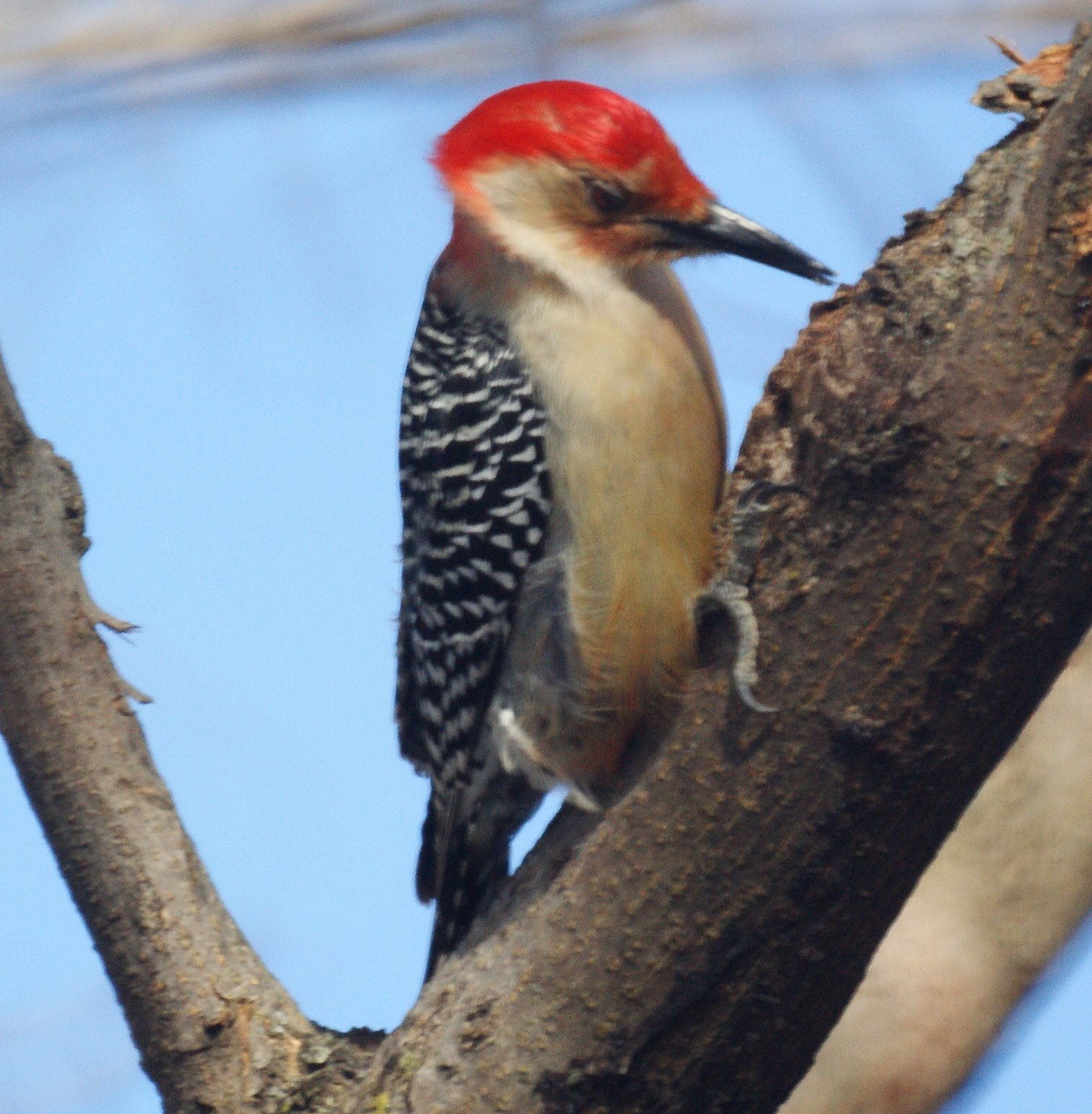
The article Space Laser Spies for Woodpeckers by Jonathan Amos for the BBC caught my eye today due to the way that I woke up this morning. I’m home in New Jersey for the holidays, and the back side of my parents house is wood so we’ve had a few woodpeckers stop by in the past.
 |
| Source: New Jersey Birds.com |
This morning I fell out of bed, startled by what sounded like an attack from robotic woodpeckers. I stumbled out into the hall, only to figure out in my half-asleep state that the noise was radiating from the inside of the house, from the plumbing. Following the noise, I found my Mom in the basement doing laundry. Apparently the noise the sink next to the washer makes is very similar to a robotic woodpecker attack. I know you all appreciated that little anecdote, but now on to the scientific side of woodpeckers.
Researchers at the University of Idaho are developing lasers that can be attached to satellites to woodpeckers in the state to determine which parts of the forests they favor. The researchers hope the satellite guided lasers will be a better way to track the woodpecker, which is an indicator species. Being an indicator species means that if the woodpecker is healthy and thriving in different parts of the forest, then it is likely that the forest itself is healthy and doing well.
If the laser-satellites prove to be a successful way of surveying for a species, it could eliminate more labor-intensive and costly means of surveying like sending people into the forest on foot to assess the environment’s health. This is an instance where I have to say, even though we still don’t have flying cars, we are definitely living in the future.
Do Flies Exercise Free Will?
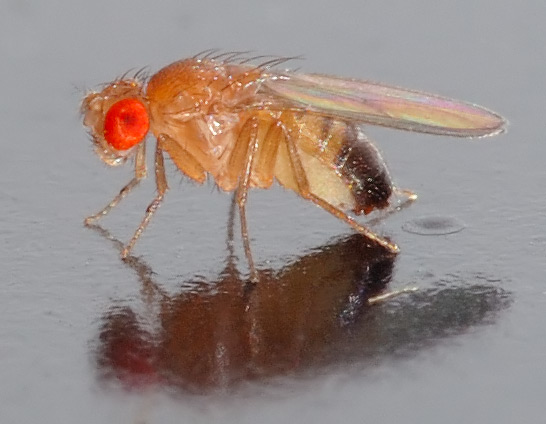
The question of whether or not organisms with less brain power than humans can exercise free will, essentially the ability to think for themselves, has long been a scientific curiosity. New research out of Berlin Free University suggests that fruit flies may have some level of free will.
 |
| Drosophila melanogaster. Source: Wikimedia Commons. |
The idea is that an organism that doesn’t have free will, always reacts in the same way to stimuli due to the way their brain has programmed them to react. Yet, experiments with fruit flies show some unpredictability to the way that fruit flies react. This suggests that fruit flies “think” on a different level that previously believed.
Now the ability to react differently to stimuli, does not mean that organisms with less brain power than humans are sentient. Sentience is the ability to be self aware, and to understand and think critically about yourself and what goes on around you. Whether or not organisms are sentient – and to what extent they may be so, remains a controversial topic.
Flying left instead of right when poked isn’t the same thing — at all. But it does suggest that we still have a lot to learn about the brain, even in teeny tiny organisms, because researchers have only scratched the surface of understanding the ability to make choices, and what it means about the capabilities of the brain.
Glow in the Dark Snails
Bioluminescence is such a cool natural phenomenon. Victoria Gill’s article for the BBC, Snails flash a green alarm light, discusses the newest organism to be discovered with bioluminescent abilities. Basically, bioluminescence is the ability to glow neon colors like a living glow-stick.
Organisms use their glow to scare off predators, and when that doesn’t work, to put the spotlight on the organism that is attacking them so that perhaps another predator will come after it.
The bioluminescent snail are interesting because the actual part of the snail that glows is located inside the shell. The opaque nature of the shell amplifies the color so that its glow is increased and the glow spreads to the entire shell.
The Ever Important Role of Facebook
Given that I check my Facebook at least a dozen times a day, I think its safe to say that I’m an addict. The more Facebook changes and expands, the more addictive it seems to become – especially with the evolution of the news feed.
This week my professors and colleagues pointed out several examples of social media, particularly Facebook, playing a role in how hard news stories are reported. I think it is definitely safe to say that Facebook is another tool in a reporter’s arsenal to get the scoop on a story, or even just to get a good feel for a situation.
One article that I found particularly jarring because of the way it used Facebook is Ian Shapira’s article for The Washington Post, A Facebook story: A mother’s joy and a family’s sorrow.
In addition to seriously pulling on the heartstrings, I think Shapira’s article also dances around the issue of what happens to your online presence after you die. The issue of “digital death” was raised by my colleague in the UW pro-track program, Marianne English in the article: Madison startup Entrustet helps people control their digital assets from The Isthmus.
Things to think about.
Leaving the Solar System
There was an interesting story today in the BBC about the NASA space probe Voyager 1, and how it is nearing the edge of our solar system. Voyager 1 has traveled the farthest of all the vessel to be launched from Earth. It will be the first space probe to ever leave our solar system.
 |
| Launch of Voyager 1. Source: Wikimedia Commons. |
What I found so interesting about the Voyager 1 probe is that it was launched in 1977, making it 33 years old. This machine has been collecting and transmitting data about space back to Earth for longer than I have been alive. I think that is pretty amazing, and it is a testament to engineering that NASA’s scientists were able to make a machine that could still function properly after all this time.
Voyager 1 and its partner Voyager 2 were initially launched to survey the outermost planets in our solar system: Jupiter, Saturn, Uranus, and Neptune. Voyager 2 is nowhere near the edge of the solar system however, because after it was finished with the outer planets in 1989 it was put on a much slower course than Voyager 1.
According to researchers, Voyager 1 should cross the threshold outside of our solar system sometime in the next five years, so this story will definitely be coming up in the news again in the future.
Advantages to Being on the Left
As a left handed person I found this article: ‘Left handed’ coiling snails survive more snake attacks by the BBC’s Victoria Gill, pretty interesting. I love hearing stories of left handed superiority. According to this article, a certain species of snail that has shells that coil either clockwise or counterclockwise is experiencing natural selection due to their shell orientation.
Due to the way snakes suck a snail out of its shell, and the way snakes jaws are formed, only snails that have shells that coil to the right are susceptible to predation. Snakes just can’t suck a snail out of a shell that coils to the left. Ha! Left handed dominance! According to researchers, the snails are starting to branch off into their own species, because eliminating the threat from snakes has been really beneficial for their population.
I’d also like to take a moment to point out that the idea that left handed people are sadistic is a myth. The word sinistrality is used to refer to left handed people because it is derived from the Latin word sinestra which means left handedness. Nothing to do with demons, sorry.
I take pride in being left handed but it can be a pain at times (like when I was learning how to write). Apparently left handed people have a shorter life span than right handed people based on accidents caused by using tools, and equipment designed for right handed people. I guess I better watch out.
But I do have good company in my left handed ways: Ronald Reagan and Bill Clinton (the likable Presidents!) Joan of Arc, Leonardo da Vinci, Michelangelo, Paul McCartney, Charlie Chaplin, Robert DeNiro, Cary Grant, and Marilyn Monroe (lots of others too I just found these the most interesting.)
Diamond Planet
New research using NASA’s Spritzer Space Telescope has shown that planets in our galaxy may be more carbon based than others meaning that the ground would be made of diamonds instead of sand (rocks, dirt, essentially what our soil is made of.)
The new planetary discovery, Wasp12b, is a gas giant like Jupiter, and wouldn’t have the water necessary to sustain life. But, just the idea that a planet made of diamonds could exist is definitely fun. Its strange how something that is such a hot commodity on Earth could be so ordinary somewhere else with just a few changes in chemical composition.
I couldn’t do a post about diamonds and not include a little Marilyn Monroe, after all Diamonds Are A Girl’s Best Friend: