My Atomic Bomb Education
I just wanted to share the New York Times’ article The Bomb Chroniclers by William J. Broad. I don’t have too much to say about it analysis wise, but I learned a few things so I thought it was worth mentioning. It is about the first tests of the atomic bomb in the US before we used the technology on Japan to end World War II.
The tests were recorded by videographers, and over the last few years the government has been declassifying the video so that it is now available to the public. The article talks about the experiences of the people who took photos and videos of the tests and also about what has happened to their work, documentaries, books, etc.
In J620 this week we talked about the atomic bombs that were dropped on Hiroshima and Nagasaki from the humanitarian angle, and in J669 we read excerpts of Hiroshima by John Hersey so the topic was already on my mind. Its always good to learn new things and I don’t really know too much about the tests that came before actually dropping the bomb to end the war so I enjoyed reading this article to learn more.
Book Review: Writing For Story
This morning I finished Jon Franklin’s Writing for Story, what I hope is the last “how to” book I’m going to have to read this semester. Textbooks aside, in the first three weeks of classes I’ve read three books focused on how to avoid complete and total blinding failure as a writer. I have found it incredibly depressing that there is even a need for such manuals. Combined with those that I accumulated during my time as an undergrad at Lehigh, I am now the not-so-proud owner of quite the collection of books on how to write.
 It isn’t that I don’t find value in these books, I think that there are definitely nuggets of good advice and even a little humor about style, format, the industry, and numerous other aspects of journalism as a profession. However, I find that I get pretty frustrated listening to someone who is considered a “success” brag about how they got there. Congratulations, by capturing the ever elusive combination of financial success, public success, and the praise of your peers you have been deemed worthy enough to hold the distinguished title of being a “good writer.” Good for you.
I think the reason I am annoyed right now largely has to do with the generalizations that Franklin makes in his book. He assumes that all young journalists are a bunch of immature children that need to have rejection beat the desire to write, right out of us before we can accept that we aren’t going to be great artists. Well Jon Franklin, I for one don’t want to be an artist, I’ve never thought of writing as my art, and I hold no misguided feelings of anguish when an editor tells me a piece doesn’t work.
Yes, I’ve struggled to find my way in terms of all the mechanics of writing, to figure out what works and what doesn’t, as my early copy from BioTechniques CLEARLY indicates. But, I just don’t consider myself some downtrodden journalist struggling to find their literary voice. I want to talk in facts, I want to write hard news, sweeping poetic literary statements just aren’t my style, and I don’t like being lumped in with every other young writer afflicted with wanting to write. I don’t like the fact that to be considered “good” I have to unlock some magical realm of literary style that will come only with experience.
Perhaps I just aspire to lesser things than my more ideological counterparts, because I see the value in literary journalism and I think its great, but I just don’t feel some terrible stinging sensation in my soul that I’m not there yet. I know I’ll get there, every piece I write I see myself getting better. Reading all of these books on how to write and what mistakes to avoid hasn’t left me questioning whether or not I can be a great writer, I know that I can be a great writer, I guess I’m just wondering if I’m not tormented by words that go bump in the night, if my desire to be a writer is strong enough.
Its troubling to me that I’m upset that where I’m at in life isn’t upsetting me. If you follow all of the “expert” opinions contained in these books I should be pulling my hair out, and I’m not. I’m also not disillusioned to think its because I’m so wonderful that I just don’t fit the mould. That’s not it. So why, as a fledgling journalist am I not depressed? According to all these how to manuals I should be.
I feel like the authors of these books could have really benefitted from a manual entitled: How to enjoy learning how to write. I am enjoying my ride and the twists and turns it takes me on, even the rejection. It might sting but it means I’m still chasing after something, and I find comfort in that. I’m in no rush to be perfect right out of the gate, and I always thought that was a good thing, but is it? Should I be more driven? Reading these books didn’t teach my how to write, all they did was make me question my personality.
Chocolate Genes
A science news story that has been circulating in the media this week is the sequencing of the chocolate genome. I know I’ve already talked about genome sequences and why I think some are more important and interesting than others so I won’t bore you with that. But, I did want to put up links to a couple of different articles on the subject because I think it is interesting to compare and contrast the headlines and leads in terms of who went for the cheesy chocolate jokes, who worked the chocolate in a subtle way, and who went for a strictly hard news angle.
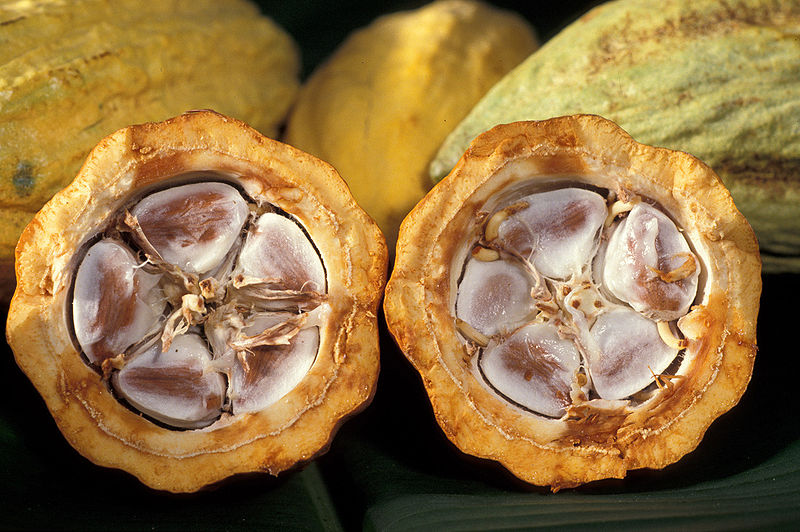 There is value to all of the approaches, so my mind isn’t made up yet on what I favor. I think if I had to choose I’d go for middle of the road approach (which is usually a pretty safe place to be) and say that you have to work the chocolate in, in some way because its what makes the story fun, but that you don’t have to get ridiculous with yourself and lose the science and the purpose of the story.
CNN: Sweet scientific discovery in the world of chocolate
ScienceDaily: Sequencing of cacao genome to help chocolate industry, subsistence farmers
GenomeWeb: Consortium Using 454, Illumina Sequencers to Decode Cacao Genome
US News and World Report: A Taste of the Chocolate Genome
SiFy News: Cacao genome sequencing a boon to chocolate lovers
CBS News: Sweet Science Cacao Genome Map Completed
Scientific American: Candy-maker releases cacao (coco) genome sequence online
Reuters: Scientists Unlock Coca Genome, Release to Public Domain
New York Times: Rival Candy Projects Both Parse Cocoa’s DNA
AOL News: Wunderbar! Scientists Crack Chocolate’s DNA Code
Overall, I think that all these articles (which are just a sampling of what is out there) have interesting differences in the way they handle the headlines and even the rest of the body of the story. It might all be about chocolate, but each news organization definitely puts on their own spin.
Crackdown on Antibiotics for Animals
I think the New York Times’ Eric Eckholm did a really good job with the article US Meat Farmers Brace for Limits on Antibiotics. As a standard practice farmers in the US give healthy animals antibiotics to make sure that they stay healthy, and to help them grow faster. I do understand the economic value of such a practice, those animals are those farmers livelihood and if they can do anything to safe guard against losing their investment in those animals I see why they would do it. HOWEVER, there is a serious impact to the environment and to public health by giving healthy animals antibiotics.
I like Eckholm’s article because he’s clear in the way he explains the new components of the story (that the FDA is considering stricter regulations on the use of antibiotics in animals, and that such actions are gaining popularity in Congress). But he also provides the background and context necessary to understand both the farmer’s point of view, and the science behind the call to end the use of antibiotics in animals because of their detrimental affects on humans.
The article also has a really nice lead by taking the story down to the level of a single pig farmer and his experience using antibiotics in his healthy animals. It imparts a literary aspect of story telling that I admire in a hard news story. I think its a good example of a writer going beyond the hard news angle and giving some really nice and necessary context to the story.
On a different, but similar, note for those of you who have never seen the Meatrix you should watch it. I love it and I think its a great way to talk about the use of antibiotics and other issue facing the meat industry (as long as you aren’t a farmer).
Phone Phobia
When I was younger (say middle school age) I HATED talking on the phone. For some reason it made me really nervous, as if the person on the other end of the phone were going to be constantly judging me. Like I was going to make a mistake, or somehow divulge some dark secret or something… not that I have any. In my line of work, its a good thing I’ve gotten over that (for the most part).
The reason I bring up my phone phobia is that as a journalist I constantly make phone calls, talking to strangers trying to confirm information or score an interview. Today I did the first of three interviews that I have to do for my first article for J800. The article is due next week, but so far this was the only interview that I’ve been able to set up. I decided to write about a recent USGS study on cyanotoxins in lakes in the midwest, so I interviewed the woman who led the study.
It was a good interview, and I got a lot of useable material for my article, so its a step in the right direction. I contacted a UW professor working on toxins in the lakes, and I contacted a local conservation group but got no reply. Tomorrow I’ll have to work on setting up the remaining two interviews — hopefully just by contacting a bunch of people/groups I’ll be able to convince two more people to talk to me.
It would pretty much make my day if this article came together nicely because as soon as its done I have to start on the next one. Oh, the joys of grad school. I always prefer to set up interviews by email first and then schedule a time to talk on the phone. I think it makes me less anxious about calling to know that someone is expecting me. Although cold calling can sometimes be very affective. I suppose in this line of work I’ll have to get more used to it.
Smaller, Better, Faster
To borrow the name-sake of my friend Cassi’s blog, We Live in the Future. I say that, because new technology just hitting the news today is reporting the creation of artificial skin that is so sensitive it can pick up on touch the way that living organisms can feel through their skin.
Reported in Nature Materials, the new technology could be used in robots to help them hold and feel fragile objects, on artificial limbs for human patients that have lost an arm or leg, or to improve minimally invasive surgery. According to the researchers, the artificial skin is made of nanowires, and is able to sense pressure changes as quickly as the human nervous system transmits such signals from real skin to the brain.
Nanotechnology is an exploding field in research, and a hot topic for science writers. But, it can be hard to explain exactly what nanotechnology is. While broken down simply it is very small technology, so small you can’t see it with the naked eye. But it has a variety of applications from biomedical applications, like the artificial skin in this article, to genome sequencing mechanisms and beyond.
Talking about nano always reminds me of the old adage “bigger, better, faster” with nano the case has truly shifted to SMALLER, better, faster.
Book Review: True Stories
Well the good news is that I seem to be fully recovered from my bout of food-induced illness, the bad news is that means I’m back full swing into my grad school work load. Last night, I finished reading True Stories by Norman Sims for my literary journalism class. The book goes through the history of literary journalism, from the reporting of World War I, the Great Depression, World War II, the lull of the 40’s and 50’s, New Journalism in the 60’s and 70’s, Vietnam, and through to the status of literary journalism today.
 In addition to Sims’ take on the history of the literary journalism style, the book also includes: The Long Fall of One-Eleven Heavy by Michael Paterniti, Red Caucasus by John Dos Passos, The Jumping-Off Place by Edmund Wilson, The Old House at Home by Joseph Mitchell, and Family Journeys by Adrian Nicole LeBlanc.
Overall I liked True Stories, it gave me a lot of important background into literary journalism and how writers need to immerse themselves in a topic and strike out on their own a bit in order to get a story that hasn’t been told time and time again. Sims made me want to devour more examples of literary journalism, particularly Truman Capote’s In Cold Blood. I might have to add that one to my to-do list.
Of the samples of literary journalism included in the book, I found Paterniti’s The Long Fall of One-Eleven Heavy to be incredibly powerful. It was emotional for me reading about a plane crash so close to the anniversary of September 11. But despite that, I thought the way Paterniti told the story without naming names added a lot of drama to the way he told the story. It was gripping, and the pages flew by. Unlike Dos Passos’ Red Caucasus which I actually had trouble focusing on and staying involved in the story.
One useful thing (I think at least) that Sims did was to include a historical list of literary journalism pieces. If you had the time, you could go through the pieces and trace the history of literary journalism through the words themselves. Although sadly I know that I, and very few people I know, would actually have the time for so much reading for the sake of curiosity. It is still useful to have the list, so you could go back and pick out select pieces to follow up on.
Where To Find A Good Article
My apologies for a lack of blog posting this weekend. It seems as though Wisconsin has conspired against me and I contracted some type of food poisoning, thus I have not been out of my apartment in the last 48 hours. But, I’m doing much better now and so I have the joy of conquering my stack of homework for this week.
In addition to my typical reading, homework for this week also includes coming up with a story idea, contacting at least three sources, and writing up a 800+ word article. I really need to get a jump on it, so I’ve spent today getting the reading out of the way and hopefully will be able to focus on the article tomorrow and Tuesday.
This article is intended to be short news, which I am very comfortable with since that was the bulk of my duty at BioTechniques, but it has one component that makes it more difficult. The three sources in the article have to represent three different points of view, which can be difficult in a breaking science story. So, that makes choosing the topic that much more important, it has to be something very specific but that has a more general impact so that there will be more people to interview than just the bench scientists.
That being said, Marianne and I were just discussing how to find article ideas. I find press releases to be the best way to find science stories, because they can help show you stories that are important, but that occur at Universities or even in countries that are far away from where the reporter is physically located. Press releases also focus on new information, so that almost always leads to an element of timeliness, which is crucial to a breaking news story.
Although, just reading the science news from other media outlets can help inspire a story, or talking to researchers and seeing what they think are important trends in their community. I’ll let you know what I decide to write about, fingers crossed a good press release won’t be hard to find.
Another Chapter on Stem Cells
More news today about the controversy over federal funding of embryonic stem cell research. A federal appeals court has temporarily reinstated the ability of federal funds to be used for embryonic stem cell research, while it takes more time to review the Obama Administration’s appeal of an earlier court decision banning federal funding for embryonic stem cell research. The issue just seems to go round-and-round.
Coverage of the court’s new decision:
The New York Times: Appeals Court Ends Ban on Stem Cell Financing, for Now
The BBC: Court delays ban on federal funds for US stem cell work
The Washington Post: Stem cell funding gets reprieve
The Associated Press (In The LA Times): Court allows funding of embryonic stem cell research for now, but projects still remain uncertain
Book Review: The Elements of Journalism
 For my J800 class I was assigned to read Bill Kovach and Tom Rosenstiel’s The Elements of Journalism – What Newspeople Should Know and the Public Should Expect. I finished it in two days, it was a quick read, but an important one. Just in these first few days of classes, I’ve been reminded how important it is for the public to build a relationship with a journalist based on transparency and verification of information. If no one trusts what you say, you can’t be a journalist. Its that simple.
So what are the “Elements of Journalism?”
(Taken directly out of the book)
1. The primary purpose of journalism is to provide citizens with the information they need to be free and self-governing.
2. Journalism’s first obligation is to the truth.
3. Journalism’s first loyalty is to citizens.
4. The essence of journalism is a discipline of verification.
5. Journalists must maintain an independence from those they cover.
6. Journalists must serve as an independent monitor of power.
7. Journalism must provide a forum for public criticism and compromise.
8. Journalists must make the significant interesting and relevant.
9. Journalists should keep the news comprehensive and in proportion.
10. Journalists have an obligation to exercise their personal conscience.
Things to think about as I start to settle into my chosen profession…