The Great Unknown
I find it astounding that even with all of the technology we now have there are still parts of the world that have yet to be explored. Even today, new species are still being discovered, which just makes me wonder how many species we have killed off without even knowing what they were.
I remember when I was in Costa Rica in 2005, our guide was pointing out species of plants that he said were new and waiting to be classified. He was hoping to get credit for finding one of them, and thus get the naming credits. It made me feel so small that there are so many different organisms in the world. I think it is the little kid in me that just wants to poke and prod and understand all the amazing new things there are to study.
In the last week a new species of bat (that was actually first sighted in the 1970’s) was discovered to be a distinct species in Ecuador, and a new species of squid was found in the Indian ocean. I find it pretty exciting that there are still things to explore.
Book Review: Rolling Nowhere
Today my group in J669 gave our midterm presentation on Ted Conover’s Rolling Nowhere. The book is Conover’s first, which was published in 1984. The premise is that as a young anthropology student, Conover spent four months riding around the county in empty boxcars with the homeless. He did it as an experiment for his thesis, but after he returned from the trip and finished his degree, he decided to turn his personal narrative of the experience into a book.
 I am pretty happy with the way our presentation went. I have an unfortunate cold, so I was a little worried I would lose my voice or have to keep blowing my nose and be obnoxious while the members of my group were presenting, but Robitussin (arguably one of the worst tasting substances known to man) kept my symptoms in check long enough to get through our 1 1/2 hour discussion.
My contribution to our analysis was to compare and contrast Conover with the other authors that we’ve read as part of our class work for J669. I also contributed a little to the questions and discussion that we had after we all presented the parts we prepared individually. We talked a lot about the ethics involved in immersion reporting, and whether or not it would even be possible to give an accurate portrayal of homeless life given that Conover was an upper middle class college kid.
Overall I think it was a success, the class definitely helped us out by participating in the discussion and bringing up issues of their own to talk about. After I asked the first question, they really ran with it (prompted by Deb) and we didn’t have to add much more to keep the class talking for another 15 minutes. Its always good when you can fill the entire time you are allotted and we did that, so I’m optimistic. I also got another paper back in J620 today and it was another A so I’m two for two in that class, which is also good.
I’m definitely headed into the home stretch of this semester. The only assignments I have left are my finals, and one more book for J669 (Sebastian Junger’s War). It has gone incredibly fast!
What Makes A Cat Tongue News?
Ok, so earlier this week I questioned what made the study on cricket testicles news, and now here I am again questioning why a scientific find is in the news, courtesy of the BBC.
Mystery of how cats lap is revealed by Rebecca Morelle is really stretching it in my opinion. I can understand how you might observe a cat lapping up water and be curious about how they do it so well, but I really don’t see why this is breaking news. Perhaps it is a slow day for science?
 When did the biggest scientific discoveries become cricket balls and cat tongues? Can’t we do better than that? Aren’t we? We spend millions of dollars on research, how are these the best stories out there (and I assume these must have been best as they led the BBC’s science coverage on the days they each ran)?
I am going to go out on a limb and say that stories like this are caused by the need to publish something (ANYTHING) quickly. With the internet it is shifting from the quality of a story to the number of stories that you can produce. I think its sad that the best the BBC is putting out is high speed video of a cat drinking as their science news. This isn’t going to entice readers to start giving a damn about science.
We can’t just cover every single scientific finding. As journalists it is our job to determine what stories are the most interesting, to track down obscure threads and follow them until you get a story that no one else has, and to inform the public about the scientific findings that they need to know about. I think there are very few people out there that would say they really needed to know about cricket testicles and cat tongues.
Seeing stories like this makes me want to change the journalistic system. I don’t blame the writer, she wrote the story she was assigned. I blame the fact that no one is willing to spend the money on investigative, in depth reporting anymore. Give reporters the resources, and we’ll deliver the goods. Without the support journalists need to get the good stories, you’re gonna get cricket balls.
Scientists Peer Into Their Crystal Ball
One of the stories highlighted on the science pages of the New York Times this week is a multimedia piece called Voices: What’s Next in Science by Carl Zimmer. I think the piece is interesting to note because it uses audio clips, pictures, and short write ups to give an overview of what scientists in a variety of disciplines predict will be hot topics in their field in the coming year.
The scientific areas featured are Space Science, Conservation Ecology, Ocean Science, Game Design, Climate Change, Genomics, Neuroscience, Engineering, Biotechnology, and Mathematics. I found these choices a little puzzling. What about stem cells, or biomedical research as a whole? The piece includes engineering and mathematics but ignores physics and chemistry, why? Also, while I find science gaming interesting and I think its a great new field for encouraging people to become interested in science, I don’t see how it fits in with the other specialities.
I also find it interesting that they use the term conservation ecology, which is specific and scientific, but then they use the term ocean science as a lump term for all the specialities that involve the ocean, and the same for space. It doesn’t really seem cohesive for me to flip flop between specific and general.
The audio clips, and the fact that the write ups are so short make this a very accessible article that I think even people who don’t typically read science news could be interested in. It is a good example of how to use multimedia, without having to go terribly out of your way as a journalist.
Creepy Crawlies On the Brain
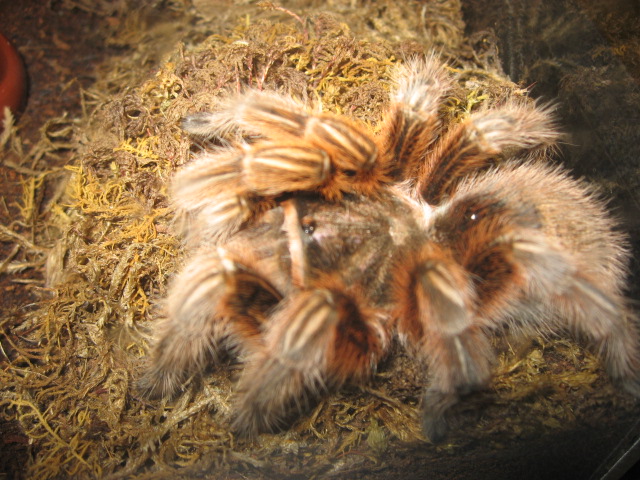 |
| Tarantula at the DaVinci Science Center, Allentown PA Credit: Erin Podolak, July 2008 |
I’m not scared of many things. I love snakes, heights, roller coasters, and being in the dark. Most of the typical things that freak people out don’t have much of an effect on me. Except spiders. I can’t stand spiders.
I think my fear of spiders stems back to being told that every year in our sleep humans EAT an average of eight spiders without even knowing it. Imagining a spider creeping along my skin and the way their little legs would feel definitely freaks me out. I’m not so afraid that I’ll run away or anything, but some shrieking is usually in order.
Researchers are now using tarantula’s to help study fear reactions in the brain. I think brain research is really interesting, considering how little we actually know about how the human brain works. Figuring out how the brain controls all the things we think and do can tell us a lot about ourselves. I feel the same way about genetics and studying our genetic code.
Tarantula helps scientists map how brains process fear was featured in the LA Times.
Promiscuous Crickets
The article: Cricket testicle size clue to promiscuous mating in the BBC was just too good to pass up for a blog post. I mean come on, cricket testicles? Who wouldn’t chuckle.
 |
| Source: eHow |
The researchers found that bushcrickets have the largest testicles of any organism, accounting for 14% of the cricket’s total body weight. The study correlated the large testicles with the promiscuity of the organism. The more the organism gets around, the larger the balls.
That this is news, and that thousands of dollars were probably spent determining this makes me laugh, and then makes me question why we spend our time and money investigating some things. I want to know what good is going to come of knowing that crickets have the largest testicles, because aside from just expanding humanity’s knowledge of insect sex I don’t really get a lot of value out of this.
A Little Politics
Since this is a science and journalism blog I try to stay out of politics. That is why I didn’t offer my commentary on Tuesday’s midterm elections. Most of the attention in the California election went to the defeat of Proposition 19 (legalization of marijuana) but I think the defeat of Proposition 23 is also important to note.
The proposition was a move to suspend California’s regulations on green house gas emissions, backed by oil companies. According to the LA Times, industry in Silicon Valley (which is investing billions in clean energy) opposed the propositions, and may have added to the surprising defeat.
The LA Times article Prop 23 battle marks new era in environmental politics is an interesting read for the way it chronicles the cross over between science, environmental activism, and politics. I have a particular interest in the way that scientific information can shape policy through informing the public. As one of the first major public votes on issues related to climate change and global warming I find these results surprising, but encouraging.
But then again, it is just California. When Texas stands up to oil companies and makes moves to reduce green house gas emissions and invest in alternative energy, then I’ll be impressed. But for now, we have a small political victory for climate science.
Help Me Obi Wan Kenobi
My experience with holograms doesn’t extend much farther than Princess Leia’s secret message to Obi Wan Kenobi, entrusted to R2D2 in the first Star Wars movie released (but really the fourth story in the series) A New Hope. Yeah, Nerd Alert, I’m OK with it. Anyway, Star Wars has shown us that holograms are something used in a galaxy far far away, certainly not here on Earth, and certainly not in present day. But alas, Star Wars has led me wrong.
 |
| Source: Wikimedia Commons. |
New research from the University of Arizona is close to making holograms a reality. So far, the group is able to film a video image and beam it to a new location where it updates in “near” real-time. The research team has been working to improve the speed at which the images are conveyed, and has gotten them as fast as every two seconds. Video with a continuous flow of images, like Princess Leia’s famous message, is just around the corner.
The BBC article by Jonathan Amos, “Hologram messaging coming of age,” breaks down the process like this:
1. A series of cameras arranged in a semi-circle take multiple images of a person or object from lots of different angles.
2. The images are fed into a computer, where they are processed and then sent to another computer at a different location
3. A specially designed 3D printing system receives the images and based on the information contained in them, controls a laser that “writes” the images onto a screen made of a special plastic.
4. The special plastic screen can update every two seconds, but a light source is needed to be able to see the changing holograms.
The researchers say that holograms will be useful for manufacturing, to update plans or blueprints as workers are designing new models. I think it has value simply for being cool and for proving to Star Wars geeks that IT COULD ACTUALLY HAPPEN, well at least the hologram part.
Harry Potter: Scourge of the Owls?
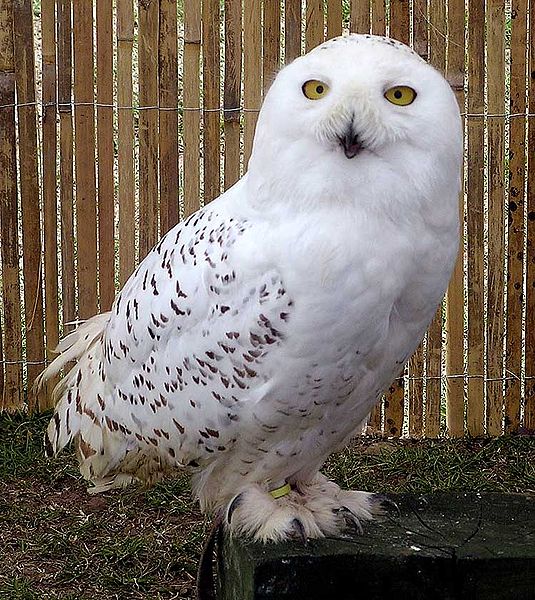
New research out of India is drawing a correlation between a spike in the black market trade of owls and the popular Harry Potter books and movies. Apparently the stories, which feature a white owl (named Hedwig,) have led to a surge of people seeking owls as pets, as well as for what the BBC calls “black magic” rituals.
 |
| Source: Wikimedia Commons. |
As a reader, I am interested in the research methods used to draw the correlation between the loss of owls and Harry Potter. I wish the article talked more about how the researcher came to his conclusion, because simply noting the popularity of a series that features an owl as a minor character (I think its minor, I’ve never actually read a single one of the Harry Potter books) is a far cry from actually quantifying its connection to a decrease in owls.
This type of investigation reminds me of the correlations made between video games and violence, or metal music and violence. I think that how studies of this type are conducted is a pretty important component to the story, because simply stating that something is a significant relationship doesn’t make it so, I want to see the numbers.
From the BBC: Harry Potter blamed for fueling India owls’ demise
1000 Genomes Project
For as long as I can remember my parents have been telling me that I’m special (in a good way, not in the derogatory way the kids are using the term these days). Most of us start life out thinking that we’re unique and the more we learn about life, and the more it kicks out asses we become so disillusioned that we cease believing we’re really all that special.
But, new data generated by the 1000 Genomes Project recently confirmed that our parents have been right all along. The 1000 Genomes Project is an effort to sequence the genes of 2,500 people from around the world in an attempt to fill the gaps in the draft sequence of the human genome left by genetic variation.
The draft sequence was established in 2000 by teams led by J. Craig Venter and Francis Collins. While that was a breakthrough moment in the field of genetics because it enabled the study of diseases caused by changes in our DNA, it only took us so far.
Genetic variation refers to the differences in the human genome between individuals (ie: if my code is AGTCAGTC, yours might be AGCCAGTC). That kind of a difference can have a huge impact on how disease manifests itself, therefore studies looking for treatments for genetic-based disorders (Alzheimer’s, Parkinson’s Disease, Cancer, etc.) are hindered by these variations.
The new data obtained by the 1000 Genomes Project, is a 95% map of human genetic variation. The results of the study show that each individual person has an average of 75 variations (single nucleotide polymorphisms, or SNPs, which are changes in the code like I described above). These variations are essentially what makes each of us different from everyone around us. My parents were right, I am special, but something tells me they weren’t referring to my genes.
This is exciting for a few reasons:
1. Millions of dollars have been invested in this project, it is good to see something actually come of it.
2. A better understanding of variation can enable more progressive research on genetic disease, from causes to treatments.
3. Genome sequencing technology is advancing quickly, and making interesting research like this a reality. Expect more projects like 1000 Genomes, it’s definitely about to get ambitious in here.
4. A project like this sets important standards for open access information and data sharing among researchers for genetic studies at this scale.
Read more: