That British Sense of Humor
I have to give Deb Blum credit for passing around this article from the Guardian that spoofs science writing. Anyone who has ever written or read science news should read it. It crushes my soul but gives me tremendous hope all in one fell swoop. Essentially, 99.9% of science news is less than stellar. At least now keeping myself out of this category is something I can strive for.
The comments that follow the article are equally hilarious and actually really add to the article, completing the satire of web media and public interaction.
My favorites:
“This is where I forgot to say that 99% of other scientists researching in this field disagree and think this scientist is a nutter” (I love that this person used the word nutter)
“This comment is simply an inexplicable and unrelated reference to Hitler”
“THIS COMMENT IN CAPITALS WILL DEMAND THAT SOMETHING BE BANNED”
This whole thing had me laughing out loud. A win for Martin Robbins.
Book Review: Slouching Toward Bethlehem
My procrastination has continued in full force – I really don’t want to write an essay now that I’ve gotten myself into article/journalist mode, but it must be done. But anyway, in addition to cleaning the apartment, running errands, taking a walk, I also read Joan Didion’s Slouching Toward Bethlehem for J669 next week as a means of putting off my essay for 620. Which I’m going to start after this blog post, I promise.
 I have been pretty critical of some of the books I’ve read for class so far this semester, but I actually really loved this collection of Didion’s essays and articles. I think she is great the way that she is so clearly a part of the text but in the news pieces she never uses first person. I guess you just really get a sense of how she views herself through her writing no matter what the subject matter.
She is also really great with one-liners that just completely stop you in your tracks as you are working through a page. I always admire writers who can set up a rhythm and then completely knock you off it without leaving a reader feeling disoriented. All of the work in this collection also use really great language, I think she is a good example of the idea that all words have a specific meaning, and that there are no synonyms. She seems to focus on choosing the perfect word for what she is trying to convey.
So overall, this one was a win. I think its also important to note that for how famous and well regarded Joan Didion is, I had never heard of her before. We’ve been talking in J669 about the new journalists – Tom Wolfe, Hunter S. Thompson, Truman Capote and I think its interesting that out of the whole bunch, Didion was the one that I hadn’t heard of.
I also have to say that the title of the book made me think of Lehigh, how I miss Bethlehem, PA.
Is There A Market for Female Science Bloggers?
Yesterday in J901 Deborah Blum gave a talk about how to make money as a writer (which certainly isn’t easy these days). One of the things she recommended was that all writers should have a blog where they promote themselves as a brand. I’m not sure how I feel about this blog representing me, but since apparently more people are reading it than I even realized I guess it really does.
Deb passed along this article from Seed, Blogging Out of Balance by Dave Munger that talks about how there are many more male science bloggers on the big blogging hubs than there are female. Some of this probably correlates with the fact that science and research used to be a boys game, but I also think it has to do with the fact that many female bloggers want to be anonymous.
I suppose I qualify as a science blogger but there is a big difference between my science writing blog and a blog that is written by a researcher. There are a lot of science writers that do have degrees in biology, chemistry, physics, geology, etc. and so can consider themselves an expert in whatever science field they choose to blog about. Since I do not have a degree in any science, I don’t think I’d want to have my blog be about a certain research field, I don’t want to make false claims about being an expert. What I know is writing, which is why this blog is all about being a science journalist, instead of about the science itself.
Interview Bureaucracy
Today I did a lot of interviewing for an article that I have due for J800 next week. I was pretty unsure about the topic, funding for addiction research, but now that I’ve spoken to several people I am much more confident that I can make it really interesting. I have all of the materials that I need to write it now too, which always makes me happy because then I have time to write the article and re-work it over the course of several days without waiting for sources down to the wire.
In the course of my interviewing, I had to track down someone from NIDA the National Institute on Drug Abuse. I considered just cold calling numbers I found on the NIDA website, but I decided that even if it took me a couple of days I stood a much better chance if I actually went through the media office. So thats what I did, and I think it worked out really well because I got the material I needed from an official source and didn’t really waste a lot of time calling around and getting re-directed. So lesson definitely learned, when dealing with the government go right for the PR people, they pull the strings.
The Chili Pepper Angle
I really don’t find food and nutrition writing all that interesting (sorry to those who do but its just not my cup of tea) but I wanted to highlight this article on chili peppers from the New York Times. A Perk of Our Evolution: Pleasure in Pain of Chilies by James Gorman because I think he takes a really interesting approach to talking about a food item.
The angle the Gorman uses is answering the question of what makes humans want to eat foods that are hot/spicy with chili flavor even though at times it can be painful? I think this is an interesting way to approach writing about peppers, and honestly I was just impressed that Gorman was able to write such a long article about the topic without it becoming boring or redundant.
There are also parts of the article that Gorman writes in first person, which is an interesting choice. The article starts off as would be expected, a soft lead that describes a chili pepper festival – hinting at the allure of the vegetables and then goes into expert opinion. So when Gorman inserts his own narrative later on in the piece and discusses his own feelings toward chili peppers I was a little surprised. I do think it works though, because with a topic that could easily slip into the mundane, the more casual feel later in the piece actually works to hold me attention.
This Is Not Polite Dinner Conversation
Francis and I have been having the most ridiculous conversations over dinner. Apparently we both favor talking about the things you aren’t supposed to talk about like religion, abortion, politics, and even global warming. I guess we are just getting a feel for each other and what we think and believe. Although I have a tendency to provide my opinions about these topics freely, which I suppose thats why getting my own voice out of my reporting was a challenge for me when I first started writing.
But on the topic of global warming, she made a fairly decent argument for why she doesn’t believe in global warming specifically (she does believe in climate change) based on the geologic record of cooling and warming trends, but she is a geologist after all. On the opposing side, I think I also made a good argument in favor of global warming and climate change. In the end it was a respectful parting of opinions, which when you share a small apartment is probably best.
This article in the New York Times reminded me of our global warming conversation, because I think it is another scientific finding that provides evidence in favor of global warming. Extreme heat bleaches coral, and threat is seen by Justin Gillis reports on the mass death of coral reefs due to high water temperatures.
According to the article, with the rising temperatures the coral are far more sensitive, so any other slight disturbance in their environment can send them right over the edge, causing them to lose their color killing the organisms that rely of them. National Oceanic and Atmospheric Association (NOAA) scientists believe that 2010 will rival 1998 as the hottest year on record, and probably the most damaging to coral. Not that you can just accept everything NOAA says, but I do think that the article presents a concise and logical argument in favor of a warming trend and its negative affects of coral reefs.
Thats So Nerdcore
I found the article Nerdcore: Hip hop for rhyming geeks from the BBC‘s Jamillah Knowles and Chris Vallance quite entertaining. The article takes a look at a new trend in the hip-hop music scene, self proclaimed nerdy people rapping about the societal struggles that come with being a geek. I’m going to refrain from expressing a staunch opinion on nerdcore rap, but I commend the reporters for chasing down and interesting topic and finding a unique angle with which to talk about the stigma of being a nerd.
I also liked the multimedia components that the reporters incorporated into this story. I think its important to get a picture of what these nerdy rappers look like in addition to hearing their actual rhymes so the video and audio clips to me really made the piece.
On a similar nerdy note, if you’ve never seen the Big Bang Theory on CBS, it is about a young group of professors and researchers (physicists, no less) at a university and it is hilarious.
And Then There Were Ducks
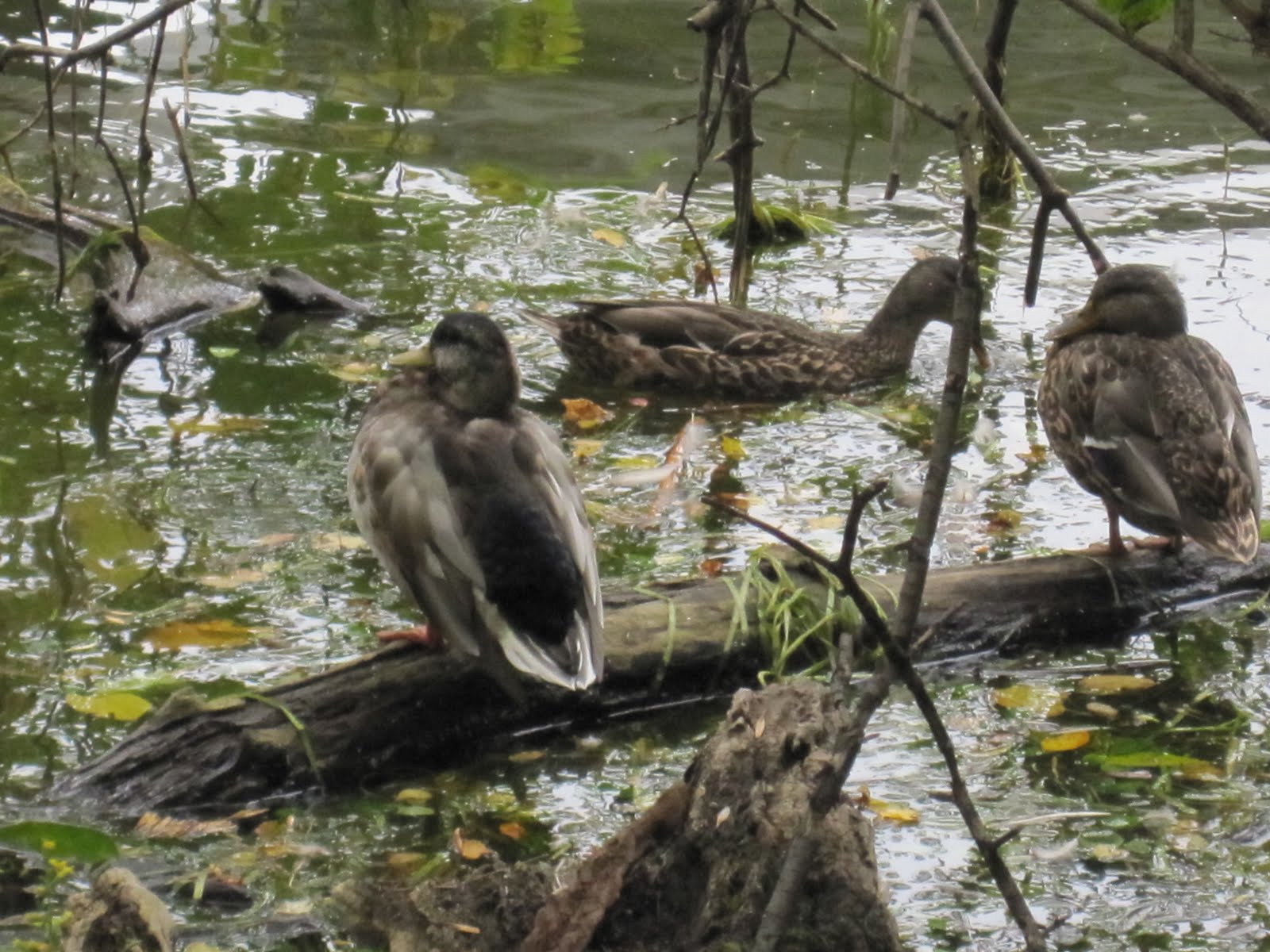 |
| Credit: Erin Podolak |
Today I took a walk on the lake front to get some pictures to go with the article on toxins in the lakes that I wrote for my J800 class. I walked for over two hours and gave myself blisters and I ended up mostly taking pictures of ducks. Good job Erin.
Although, there is something to be said for simply getting outside and going for a walk. I’ve found that Madison has a lot of good walking trails right near campus that offer you a way to get out and be in semi-natural surroundings without having to go far from the UW campus.
At least they ducks are cute, and I did take a few shots that I can use for my article, mostly warning signs for toxic algae blooms. I’m not sure how I feel about the idea that journalists are supposed to now be able to do all of their own multimedia to accompany their articles. I don’t mind taking pictures because I’ve always liked photography but I definitely couldn’t make some of the graphs and maps that you see accompanying articles. I guess I’ll have to learn to keep up in this business though, and something tells me my ducks certainly won’t cut it.
Book Review: Fear and Loathing in Las Vegas
For J669, my literary journalism class, we have to read Hunter S. Thompson’s Fear and Loathing in Las Vegas. I sat down last night and read it in one shot, it took me about three hours which really wasn’t that bad. Its hard to critique a work like Fear and Loathing in Las Vegas because it is so famous, but I do have a few thoughts about it.
 I didn’t love it, but I didn’t hate it either. It was really hard to look at it as a piece of journalism, although I can actually see pretty clearly how the piece is almost like a stream of conscience list of what happened during Thompson’s drug binge in Vegas. I like that he uses a fake name, and that name (Raoul Duke) becomes like a fictional character. I think what made it so hard to take seriously when it was written is that he describes all of his acid trips and subsequent illusions with complete and total seriousness, not really acknowledging that they are just fantasies created by LSD. He also chronicles his paranoia with complete and total certainty, which also gives the piece more of a fiction feel.
Overall I think that Fear and Loathing in Las Vegas falls into the realm of journalism because it is a very accurate record of Thompson’s memory of his trip to Vegas. I think its true to his memories, and what isn’t in his memory is apparently on a tape recorder. I think it is what happened during the trip, I just think it rattled cages because it shows such an extreme case of drug use. Its also notable for the fact that he didn’t write either one of the articles he was assigned, the desert race or the drug enforcement meeting.
For anyone who wants to learn more about Hunter S. Thompson I whole heartedly recommend Oscar-Winner Alex Gibney’s documentary film Gonzo: The Life and Work of Dr. Hunter S. Thompson, and not just because the director is from my hometown. The film tells the story of Thompson’s life from birth, through the peak of his career, to his suicide in 2005. Gibney gets an insider view of Thompson’s funeral, rocket and all. It also has Johnny Depp, which pretty much makes it a win.
Hip Hop Meets Chemistry
An interesting article today in the UW paper, “UW-Madison student mixes passions for science, dancing.” The video that accompanies the article is actually pretty awesome, provided you want to see a guy dance hip hop style covered in glowing chemicals, and really who wouldn’t.
The article explains how UW-Madison student Jeffrey Vinokur combined his love for chemistry and dancing to create the act the Dancing Mad Scientist, which finished in the top 100 out of more than 70,000 auditions for the NBC show America’s Got Talent. Vinokur’s hometown is Montvale, New Jersey, so clearly as a Jersey girl myself, it caught my attention.
I think its great that Vinokur is taking his act to schools and helping people get excited about chemistry, but I do have to point out that in the video where he talks about chemiluminescence he never actually explains what it is. He explains how a glow stick works. This is not at all the same thing as explaining WHY certain chemicals glow when you combine them.
If you do want to learn more about chemiluminescence check out this link:
http://www.chemistryexplained.com/Ce-Co/Chemiluminescence.html