Storytelling At the Washington Post
In two of my classes this week Manuel Roig-Franzia came in to talk about his experiences writing for the Washington Post’s Style section. After listening to him speak, I came away with almost a sense of awe at how ingrained it seems to be in him to tell stories.
For almost an hour today he just talked about the stories he’s covered and what talking to the people he interviewed was like. He started off telling us about traveling to Haiti in the wake of the Earthquake earlier this year, and went on to discuss interviewing Bill Bond a man who fully admits to having killed his father (but who never served any time in jail for it), and getting the scoop on the White House puppy. Yesterday I heard him talk about his work covering lobbyists in Washington D.C. based on articles about Heather Podesta and the restaurant Tosca.
Typically listening to someone talk for an hour straight could get really boring, but I found Roig-Franzia’s anecdotes about his work reporting to be highly entertaining. Not anything that I think I can really use in my own career mind you, but the guy can really tell an interesting story.
For those who don’t know, Roig-Franzia caused quite a stir last year for his role in a fist fight that broke out in the Washington Post newsroom. I don’t advocate punching people in the face, and I won’t weigh in on whether Roig-Franzia deserved it, but I will say that it is a rare person who is enough of a bad ass to call their boss a cock-sucker and keep their job.
What Would Kurt Cobain Do?
Today in J620 we finally moved from discussing the history of humanitarianism and how the media works for and against humanitarian groups to the part of the class that incorporates celebrity. I did enjoy learning about humanitarianism in the sense of just building my knowledge base because I have no background in it, but I am looking forward to discussing how celebrities interact with the media.
In starting our discussion of celebrity, my professor brought up the fact that her favorite band is Nirvana. I don’t often have professors who profess their love for grunge or who have a Kurt Cobain poster in their office so I found that amusing. My professor said that when she’s having a bad day she’ll look up at her poster and think “what would Kurt Cobain do?” and she usually comes to the conclusion that her situation really isn’t that bad.
But anyway, Nirvana was a segue into discussing what makes someone a celebrity and how celebrities can cause social movements. Michael Jackson, Lady Gaga, and Bono were the other celebrities that the conversation seemed to center around.
I find it kind of funny that for the most part everyone seemed to have a pretty extensive knowledge of celebrities, its like we all have this fascination that we try to keep hidden because we’re supposed to be intellectuals. I guess that is why I appreciated my professor’s Nirvana comment so much, it is always fun to see people divulge little parts of themselves. I find that especially true with music, and what certain people are drawn to. I love when people can surprise me.
In other news I got an A on my first paper for this class, which was a big relief for me since I was really scraping the bottom of the barrel in terms of my knowledge of humanitarianism.
Since I’ve now been inspired to re-visit Nevermind, I’ll leave you with Nirvana’s Lithium, which I argue is one of their best.
You’ve Got Mail
Even though I long abandoned AOL for Gmail, I still find it fun to see my email inbox full, even if a creepy computer voice no longer announces the presence of my new email. As I’m working on my new article topic for my J800 feature (which triggered my seething frustration and puppy-picture needing earlier this week) I’m running into the problems presented by email interviews.
I prefer to do my interviews over the phone, but I like to have an appointment set up, I find it easier for everyone than cold calling because no one gets caught unaware. Which reminds me of the time I interviewed National Medal of Science winner Elaine Fuchs on post-its when I was dressed as Wonder Woman last Halloween because I wasn’t expecting her call, (the article didn’t really turn out that bad) but that is an unnecessary tangent.
Anyway, there are pro’s and con’s to the email interview, but for my latest topic I really just needed someone to talk to me to give me background, and that can’t be done on email –it takes too much space and time. So after getting three requests for email interviews (which is largely due to the fact that I email before hand to set up an appointment, my own downfall) I was very happy to finally have one source come through over the phone.
I’m feeling much better about the whole thing just having the one interview under my belt because I have a better grasp on the topic and my source recommended other people for me to talk to (fingers crossed they’ll be available by phone too.) I know there are some publications that make a point of not allowing email interviews, but I don’t think they are all together bad. Email has its place in the proverbial “writer’s toolbox” you just can’t rely on it all the time.
You really can’t build an entire article based off of emails, you need to get at least one source on the phone. But, email can be useful for getting direct comments from very busy people. Case in point, I would never have gotten comments from Francis Collins for an article I did for BioTechniques on the Rock Stars of Science campaign if I hadn’t caught him by email. I would never have gotten him on the phone in time for the article because I would have had to go through his secretary and it would have gotten messy from there.
So email can be useful, but I still think that when you need a lot of information its best to actually talk to someone. You can’t switch gears, or go off on tangents on email which is I think my biggest problem with it. You also can’t gauge a source’s reaction to your question. I find it strange actually that so many people prefer emailing responses to questions because I think it takes way more of their time to do so than to just answer a few questions verbally.
I also think I like the phone more than in-person interviews because I think it makes people less nervous to just talk into the phone and not see my typing away frantically. I think when people see you taking notes they clam up and in my experience I’ve gotten plenty of people to really open up on the phone. Every journalist has their own way of doing things, and I’m sure there are those that would completely disagree with me, and maybe as I get more experience my opinion will change, but for now I think the phone works best — provided I can get someone to answer it.
Nobel Prize Science Winners
Every Fall the Nobel Prize is awarded in six categories: Chemistry, Physics, Physiology and Medicine, Literature, Peace, and Economic Sciences. It takes a long time to win a Nobel Prize (unless of course you are Barack Obama) and most awardees in the sciences end up being honored for initial discoveries that they made years ago that have had a tremendous impact on society since their discovery.
This year the winners are:
Physiology and Medicine – Robert G. Edwards for developing in vitro fertilization, which most people know is a way around infertility to help people have children who otherwise wouldn’t be able to.
Physics – Andre Geim and Konstantin Novoselov for discovering the “two-dimensional material graphene” which is basically a new carbon-based material that is very thin but very strong and is useful in experiments in quantum physics.
Chemistry – Richard F. Heck, Ei-ichi Negishi, and Akira Suzuki for “palladium-catalyzed cross couplings in organic synthesis” which is a method that helps organic chemists stabilize carbon atoms so that they can be manipulated and used in research.
The prizes in Literature, Peace, and Economic Science haven’t been announced yet, but they will be on October 7, 8, and 11 respectively so be sure to check the news for those winners it is always interesting to see who gets recognized, and sometimes the results can be shocking (like Obama’s win in the Peace category last year.)
Here is some more coverage of the science winners:
MSNBC: Test-tube baby pioneer wins Nobel Prize in Medicine
Scientific American: Robert Edwards Wins the Nobel Prize for Physiology or Medicine for Pioneering In Vitro Fertilization (by the way, way too long for a title)
Physics Today: Andre Geim and Konstantin Novoselov win 2010 physics Nobel for graphene
Associated Press: Nobel Prize honors super-strong, super-thin carbon
USA Today: 2 Japanese, American share Nobel Prize in Chemistry
Associated Press (via MSNBC): Trio wins Nobel for key chemical tool
Calculus, Zombies, World of Warcraft & Mean Girls
So after flipping out this morning about my article falling apart, I rallied myself and attended a lecture by UW’s Science Writer in Residence Jennifer Ouellette. She specializes in physics as a freelancer and has written three books. Her lecture was called “Dangerous Curves: How I Learned to Stop Worrying and Love the Calculus” which was about the research that she did for her most recent book about math and how it can be applied in everyday life: “The Calculus Diaries: How Math Can Help You Lose Weight, Win in Vegas, and Survive a Zombie Apocalypse.”
I had hoped that her lecture would be about what it was like to write about a subject that she has no background in (the calculus) but it was actually more about why she thinks math is cool and people should appreciate it. It was still an interesting lecture, and I give her credit for drawing an audience that merged the interests of undergrad journalism majors and graduate math students. For the record, graduate math students seem to function on an entirely different plain, and I for one do not speak graduate level math.
 Ouellette did a great job of bringing in different clips and examples of how math is applicable in everyday life. She showed part of the television show Numbers (which isn’t on air anymore, but is an interesting example of how to use math for dramatic crime fighting) and the mathlete competition from the movie Mean Girls, where a less controversial Lindsay Lohan realizes that it is okay to like math.
The zombie part of the title of her book has to do with a researcher who created an equation to figure out how best to survive a zombie apocalypse. Of course it is a multivariable calculus equation, which ultimately concludes that getting a gun and blowing away as many zombies as fast as you can is your best bet (although I think I could have concluded that without the calculus.)
The most interesting part of her talk for me (and the sorority girl in me does cringe to admit this) was when she starting talking about the game World of Warcraft. Apparently there was some sort of blood disease (similar to a highly contagious pandemic) that started spreading to the avatars in the game that was created by a player and started spreading rapidly through the program and the game actually had to be reset by its administrators to avoid all the characters dying of this plague-like disease. She brought it up as an example of how there can be technical models for real life situations, which actually didn’t have much to do with math, but is interesting from a science-health angle.
Overall, I’m not sure how useful her talk was in terms of helping me as a science writer, but it was entertaining, it got me out of the apartment, and I got away from my frustration over my article for a little while. I think I have my article situation figured out, sometimes just scrapping an idea and starting over from scratch is the best solution. I’m now feeling optimistic, so if only my eye would stop twitching things would be back to normal.
Ouellette’s blog Cocktail Party Physics is also a good example of science writing on the web, so be sure to check it out if physics is your thing.
Book Review: Psychotic Reactions and Carburetor Dung
For the last week I have been trying to read Psychotic Reactions and Carburetor Dung by Lester Bangs. It is a collection of articles about music that originally ran in the 1970’s. It is one of the worst things I have ever read, and I choose to read scientific reports for a living. As I was working my way through it I kept asking myself, am I just not getting it? What am I missing? Is this like when I read Tess of the D’urbervilles and hated it because I didn’t realize that the main character had gotten raped (which is the basis for the entire story) and then got completely owned in class the day we discussed it??
 I’m still not sure if the articles are actually as awful as I perceive them to be, or if I’m completely missing the point, but I guess I’ll find out in class this week. For short pieces I found them incredibly hard to follow, and as music reviews I would say that most of the time I couldn’t even tell whether or not he liked the album or artist he was talking about. It reads like a ridiculous stream of conscious, that goes off on completely unrelated tangents that in my opinion add very little to the writing. He also uses the longest sentences. A single sentence should not take up a whole paragraph, thats just bad technique. Actually, its the absence of technique, which is really all that Bangs style of writing is.
I wish someone would pay me to say whatever I damn well please, but until this blog gets bought and turned into a TV show (which is obviously my life’s back up plan, lol) I’ll have to settle for writing for my audience and employers. If only Bangs had such constraints. His pieces read like sprawling blog posts with no point, but lots of stories and personal opinion. He literally just says whatever he wants.
The only piece in the whole collection that I liked at all was his article on The Clash. I may be jaded because personally I love The Clash, but this article actually made sense. There was a point, which Bangs proved by painting the scene in a literary way. He describes his personal interactions with the band to prove how they are different from all of their peers in the way that they care about their fans. It is an argument that he is able to prove, and he does. It is the only piece in the whole collection with that quality.
In other news, I hate press releases that are misleading and confuse me because I read them when I am half asleep so that I leave messages for potential sources early in the morning that have nothing to do with what I want to write about and don’t realize it until I get ahold of the PI hours later. So tomorrow I get to clean up my mess of messages, so that I can track down sources for an article due next week. Fun times. But there is always Rock the Casbah, and for today I guess that is enough.
A Fossil Named Pedro
Francis and I were talking the other day about people who name objects. I can think of a few people who have named their cars (Oliver, Scarlet, the Mistress…) and Francis said she has friends who have named various other inanimate objects ie: a hammer named Fred. Then there is the issue of nicknaming people, which as a person with a short first name I’ve never really experienced (we will not discuss the name I got from a sorority pledge two years ago, and I do not count it as a nickname.) There is also the issue of choosing to call people a different name because it is a complete juxtaposition to what they are actually like, which makes it funny (for example calling the baby Carlos in the movie the Hangover).
I bring up nicknames because I was reading the article “Ancient Giant Penguin Unearthed in Peru” by Katie Moskvitch in the BBC, and the one fact from the article that stands out most in my memory is that the researchers uncovered an ancient penguin fossil, and chose to name it Pedro. Really, researchers? Why Pedro? Please tell me it is not because you were trying to name it something of hispanic-sounding origin simply because it was unearthed in Peru. How expected.
Why name it at all? When a new species is discovered it is given a scientific name, (in this case Inkayacu paracasensis) which is more than good enough to identify the fossil. I don’t think calling the fossil Pedro makes any more sense then calling a hammer Fred. But there is a long trend of researchers giving nicknames to their fossil finds, most prominent is probably the “Lucy” fossil found in Olduvai Gorge (the controversy over which I will not go into here) that is named after the Beatles song Lucy in the Sky with Diamonds.
I can sort of understand naming a fossil, within the context that some of these researchers work their whole careers to make a find of the magnitude of a huge ancient penguin, and therefore feel a sense of attachment to it, and want to name it the way you would name a pet. I do get that, but honestly this is not a goldfish or a puppy, if you work so hard to find something of important scientific significance that should be respected and learned from, why would you ruin that reverence by calling it Pedro?
So there is my personal rant on naming scientific discoveries. If you want to name your houseplant, your car, or even all the inanimate objects in your home, its your life. But I think that giving important fossils goofy names diminishes their importance in the eyes of the public, and these finds (and the researchers who have worked so hard to uncover them) deserve more than that.
Historical Documents
I consider letters historical documents. I think that when you put words down on paper, even in the casual form of a personal letter it becomes a piece of history. It records what you were thinking at a specific time and place, sealing a bit of history onto paper. I love seeing an envelope in my mailbox, so in the age of email I am lucky to have a few friends that love mail as much as I do, and so write me letters in exchange for me filling their mailboxes.
I just got a letter today from my friend Cassi, and have been wanting to write a reply all day, but have been tremendously distracted by my paper on the American Red Cross, among other things. The paper is for J620 my International Communication class — we are studying the media of humanitarian movements, which has nothing to do with science writing but as far as electives go I’m learning a lot. It is due tomorrow and my brain is totally tapped out so I’m taking a break from editing to blog (although blogging isn’t exactly relaxing for my brain.)
Anyway, I was already thinking about letters and how much I love and appreciate all of my letters, when I saw the article “Rivalry Among DNA Sleuths Comes Alive In Letters,” by Nicholas Wade for the New York Times. I am very tempted by the field of science history, if I were ever to turn academic instead of professional I would definitely be interested in exploring the history of science journalism, which in my opinion would include correspondence between scientists (if it becomes part of public record of course.)
The authors of biographies of Watson and Crick (the scientists credited with discovering the double helix structure of DNA) told Wade that the newly found letters from Crick’s personal documents don’t really add anything new to the historical record of the research that led up to the double helix discovery, but do add personal anecdotes to the rivalry that existed between the researchers at the time.
The correspondence also added a bit to the sympathy that I feel for Rosalind Franklin. She is a researcher who was working on finding the structure of DNA, and she had done all the research and documented everything that she needed to unravel the structure — she just didn’t realize the significance. Watson and Crick are the ones that took Franklin’s basic research and realized that DNA has a double helix structure. I’ve always felt that Franklin got gypped when they were giving out the Nobel Prizes, so I feel for her, she was so close! The snippets from the letters in Wade’s article just reminded me of that.
The Sawatsky Approach
For J800 we had to read a piece by Susan Paterno from 2000 called The Question Man about reporter John Sawatsky and his method of reporting. Of all the things that I’ve read thus far this semester I found this one article the most helpful.
Basically the idea behind the Sawatsky approach to reporting is that when an interview fails and a source doesn’t open up it is usually because the journalist asks the wrong questions. What he means by that is asking a question that can be answered with a simple yes or no, will always generate that singular response and won’t force a source to elaborate. If you ask open ended questions like how does that make you feel, or what do you think about that will force a source into talking at least a little bit more.
This might seem like a pretty basic concept, but in all of my journalism instruction no one has bothered to point this out. I think that remembered to revert to open ended questions if an interview starts to go poorly is something that could save an interview and avoid wasting your and your sources time. This approach is definitely something I’m going to try using in the next interviews that I have to do for class, namely the two feature articles that are due in October for J800.
I also have to point out that he is Canadian, which makes me think of my friend Cassi, which makes me think of this:
Obama-Rama
Today I failed at getting to see the President of the United States. Obama was speaking at UW as part of a campaign tour for the midterm elections in November. The Senate and Governor races in Wisconsin are pretty close, and I guess that makes the state a key one for the Democrats.
 |
| On Bascomb Hill. Credit: Erin Podolak |
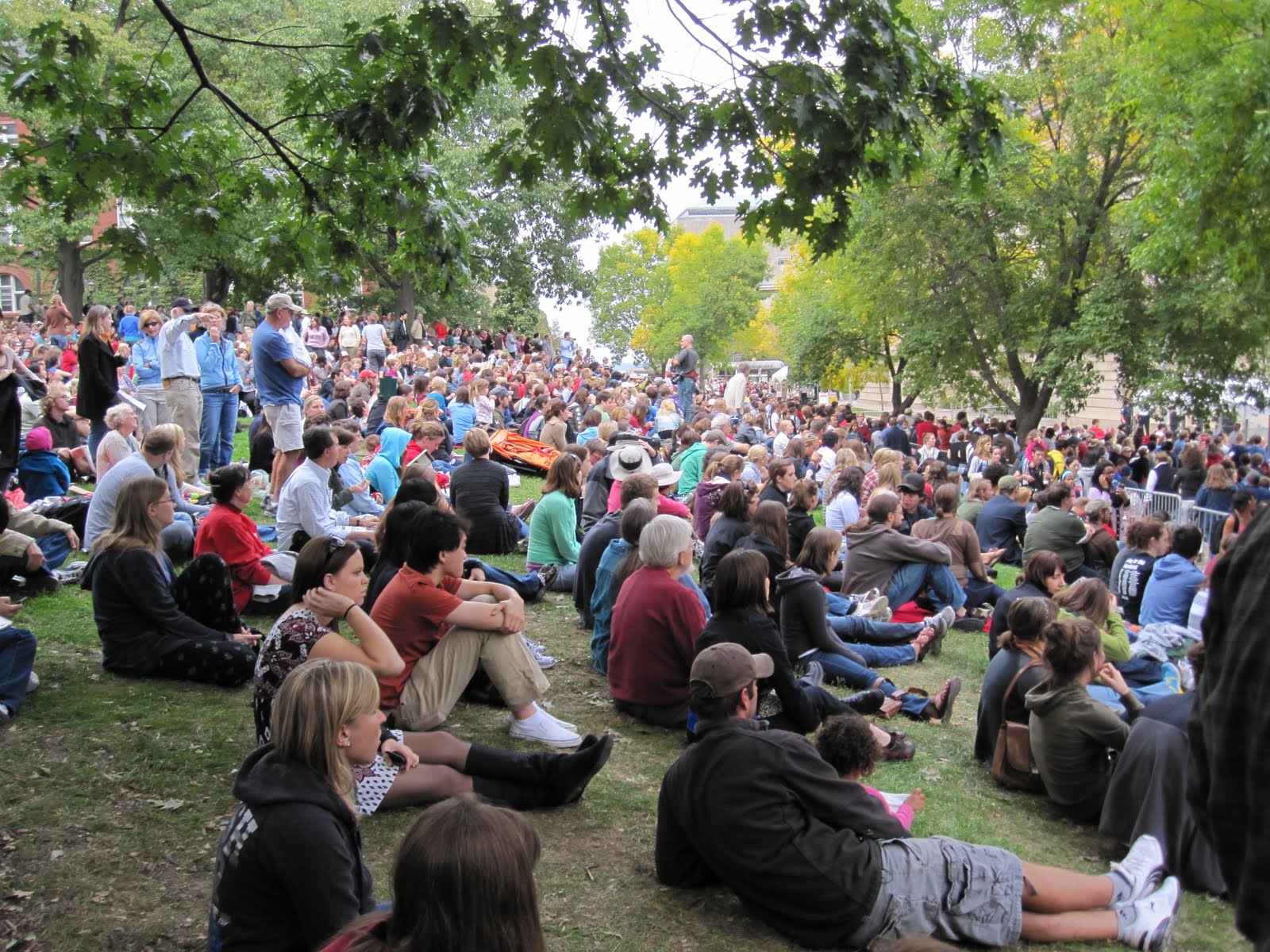
The President spoke on the library mall, which is a pretty small area on campus. The gates were set to open at 3:30 and he was going to go on at 4:45. I joined the line at 2:30 and after waiting until 5:00 was told that the library mall was at capacity and they weren’t going to let anyone else in. Really lame. But, the good news was that the President was late so I hadn’t actually missed anything yet. So, I parked myself on the lawn in front of Bascom Hall so I could at least listen to the speech as it was taking place. The rumor is that 17,000 people made it inside the rally and another 10,000 sat on Bascom Hill where I was.
The event started off with music from The National and Ben Harper – although I have to say I enjoyed the Obama transition soundtrack more (Bon Jovi and Bruce, my Jersey loves.) Then, Russ Feingold (Democratic Senator) and Tom Barrett (Democratic Mayor of Milwaukee, and candidate for Governor) each spoke. I’ll keep out of the politics because A. this blog is not political, B. as a journalist it wouldn’t be right for me to give my personal political opinions, C. I know very little about Wisconsin politics.
 |
| Best view in the house. Credit: Erin Podolak |
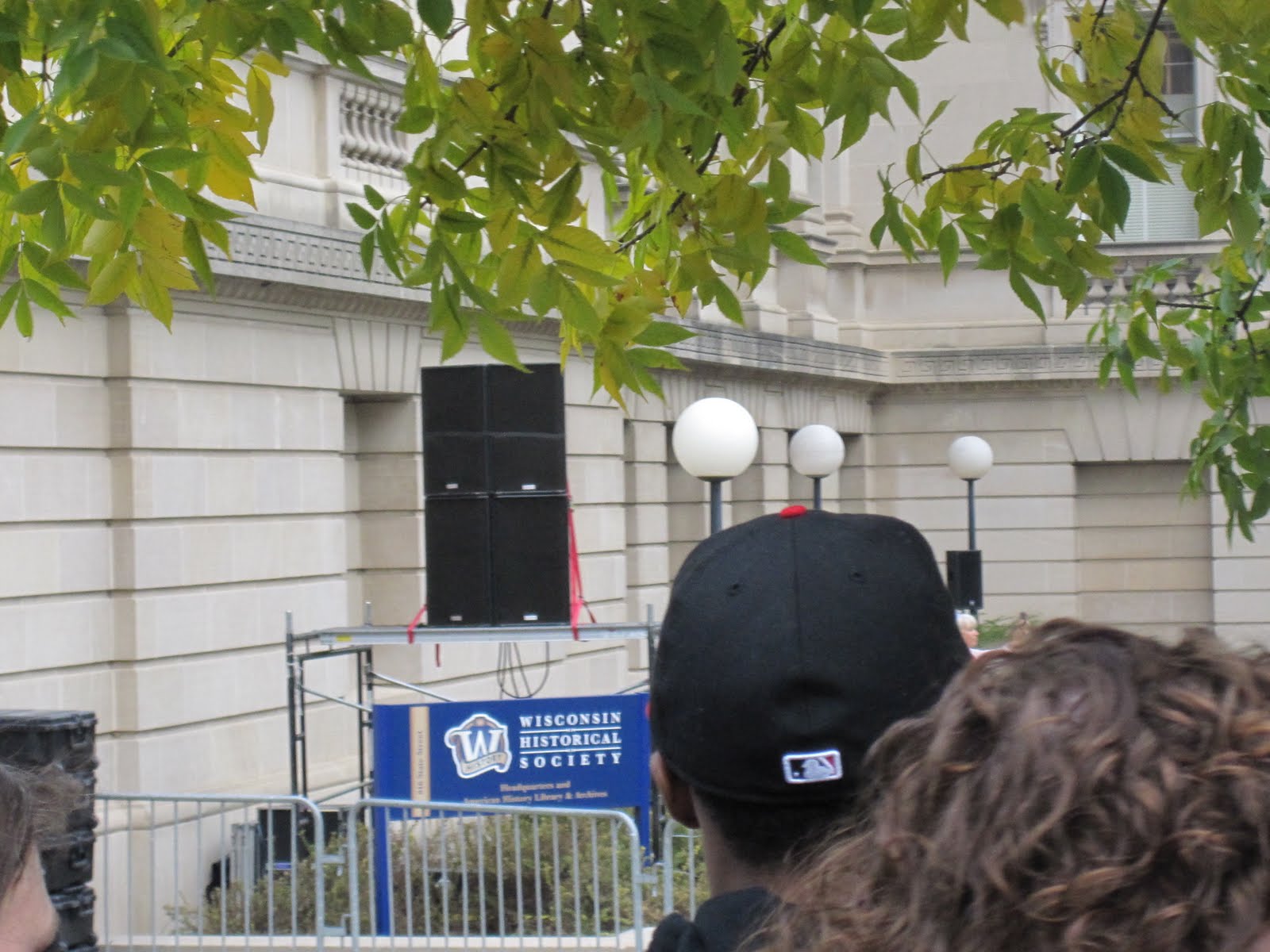
While we were waiting for the President to take the stage, I found myself thinking about why I voted the way I did in 2008, and the changes that have taken place in the last 20 months that Obama has been in office. Hearing the President speak, and to a large regard defend himself and his party, was a really good experience. Even though I didn’t have a visual, hearing his voice boom out of the PA system was still exciting.
I thoroughly enjoyed the crowd that I was sitting with, there were some very entertaining people around me. My favorite might have been the Republican who kept making snarky remarks to counter what the President was saying, who would occasionally find that he agreed and had to mark those moments by shouting “true dat, true dat.”
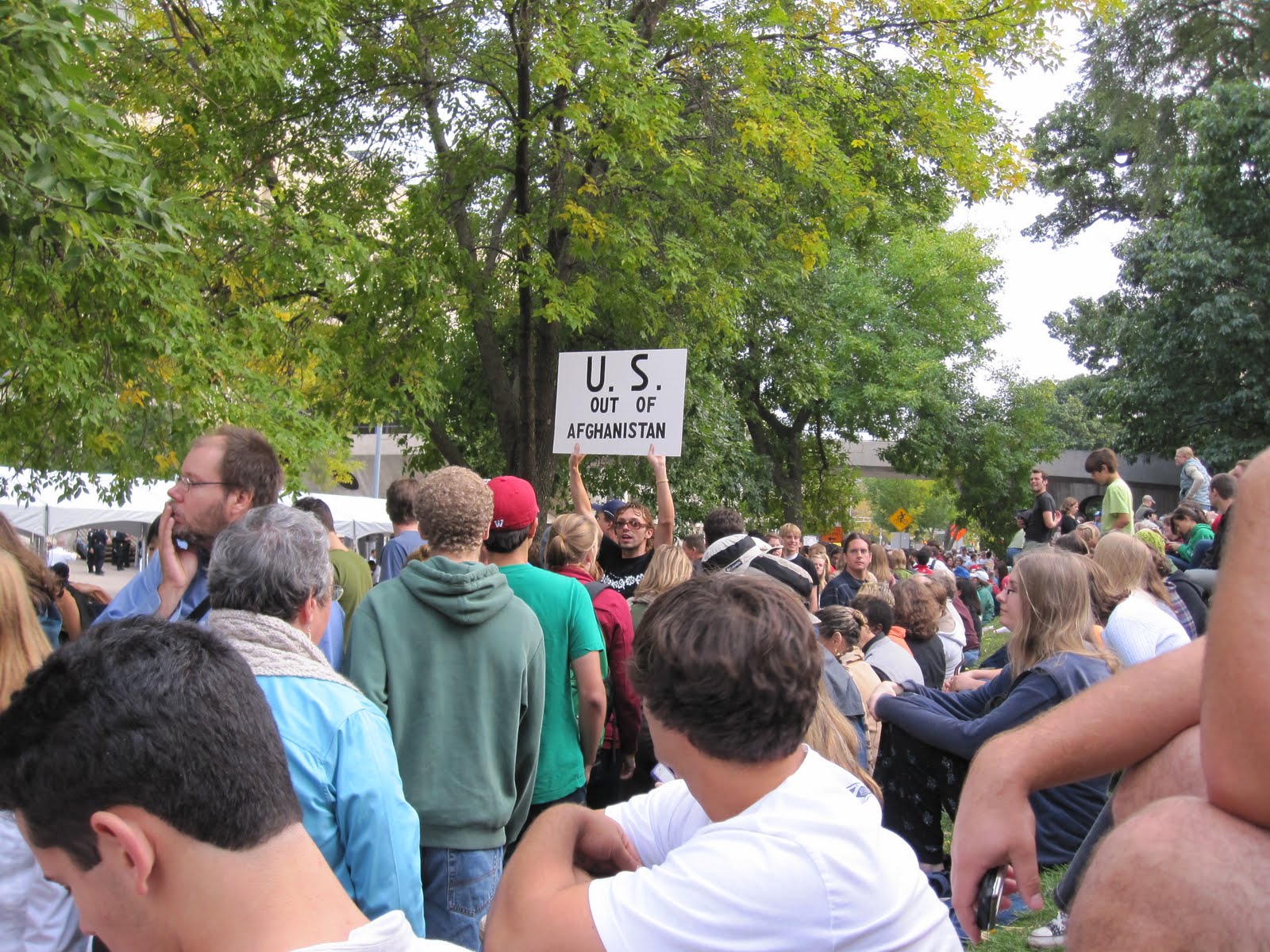
There were also a few activists/protesters in the crowd, most of whom I found really annoying. There was one carrying a sign saying that 9-11 was covered up by the government and the attacks really came from within the United States. He made me angry, and I did not mind when the aforementioned Republican decided to heckle him. The same protester was also apparently against the presence of soldiers in Afghanistan.
 |
| Credit: Erin Podolak |
Overall, I am really glad that I stuck it out and stayed outside to hear the President speak live, even if I wasn’t able to get in to actually see him. It was kind of like listening to a gigantic pep talk, that honestly kind of cheered me up a bit. It was the first political rally that I’ve ever attended, but I hope it won’t be my last because even if you don’t agree with the politics of whoever is speaking, it is just great to get out and be around that kind of a group of people to experience that little swatch of the public.
New York Times coverage of the event: Obama’s Visit Was Not Simple